Roofing contractor, US Midwest
A new account with no history, in a market at $28 a click
$180 per lead on $4,500 a month, against a $10,000+ average job. Landing page conversion rate: 6%.
This is the Elite Roofing case study below.
Before and after
Three accounts, taken from our own files. Each card says first what kind of account it was. White label client names stay private.
Roofing contractor, US Midwest
$180 per lead on $4,500 a month, against a $10,000+ average job. Landing page conversion rate: 6%.
This is the Elite Roofing case study below.
Sporting goods retailer, ecommerce
Six months. Tracking and the product feed were fixed first, then spend went up ten times.
Local service account, run for a partner agency
Conversion rate went from 1.7% to 3.7% on a budget under $1,000 a month. Small numbers, shown as they are.
The report went out under the agency’s name.
We publish our work
Most providers claim expertise. We publish the work, and that is the standard your clients’ accounts get. Elite Roofing and Beaver Builder are direct-client Google Ads results, not white label results.
Original research
Platform-reported numbers were off by 5x until we reconciled them against real records. We published how that happens, so you can check your own accounts.
Read the benchmark →Case study
Home services lead generation rebuilt around real business economics.
Case study
Google Ads for an established software product, managed for growth.
Guide
The exact thinking we use when catalogue and feed structure decide whether PMax can scale.
The vetting standard
Run them on every provider you consider, including River Stone.
In writing
The first question every agency owner asks, usually indirectly: will you steal my clients? Fair question. Here is our answer, contractually.
Yes, we also serve direct clients, and you can see them on this site. We would rather you know that from us than discover it and wonder. The non-solicit is what protects you, and it is not negotiable in either direction: we sign it every time. If you want to see exactly what those clauses should say, our white label agreement guide spells them out.
If Google or another vendor contacts your client directly, see what to do when Google contacts agency clients directly.
We do not approach, pitch, or accept your clients, during the engagement or after it ends.
Your client list, your pricing, your margins, your processes and your internal notes stay confidential.
Reports in your template, communication under your name, and no direct client contact unless you ask for it.
They are redirected to you, and you are told the same day. No quiet side conversations.
What agencies say
Real reviews, in their own words. Robby’s is on video.
Before River Stone, we were spending on Google Ads without real clarity on what was driving revenue. They audited our account, identified wasted spend and tracking issues we didn’t even know existed, and rebuilt our campaigns around actual business economics. Our ROAS improved significantly, CPA dropped, and for the first time our leadership could trust the numbers.
“Their optimized Google Ads reduced wasted spend and aligned with our B2B sales cycle, delivering qualified leads and measurable pipeline growth.”
“Anand and team are brilliant and handle our work and consistently deliver great results. They are very knowledgeable and take care of everything.”
The report itself
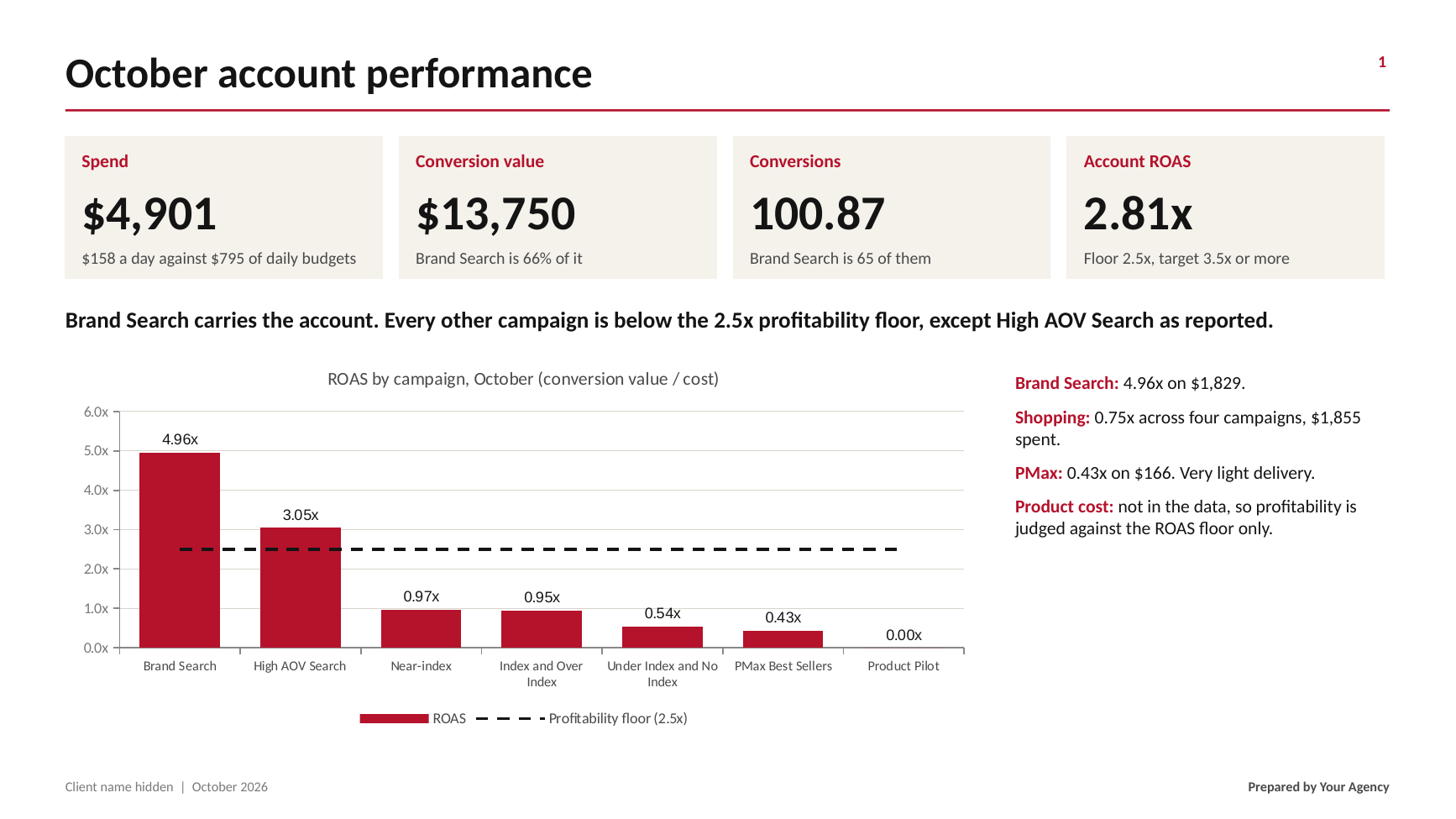
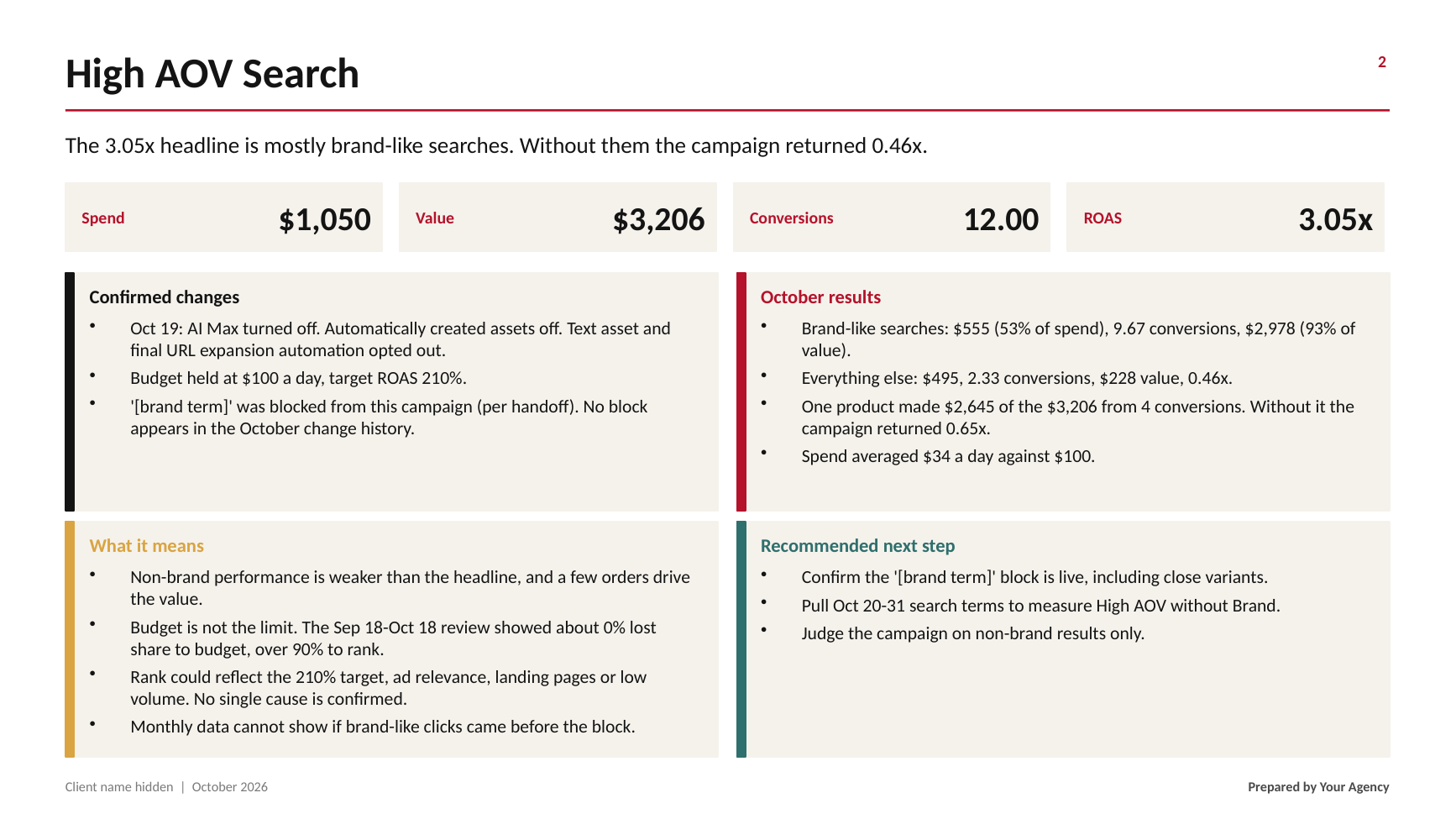
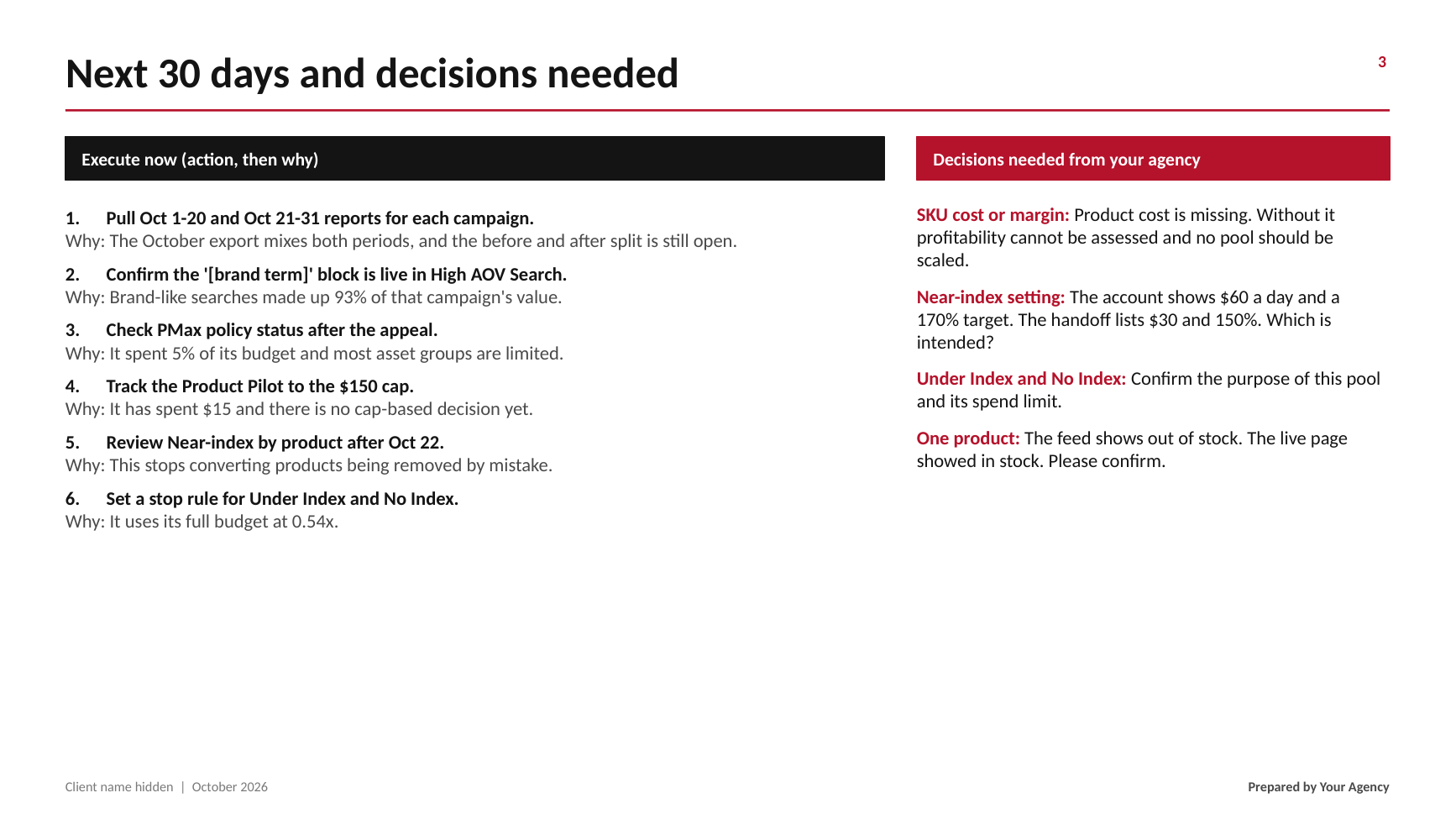
This is an October report we wrote for a white label partner. It went to their client under the partner agency’s name. Names are hidden. The numbers are real.

Spend, value, conversions and ROAS, with the one sentence your client needs to hear first.
Your version carries your logo and your client’s name. Nothing in it mentions River Stone. More in our white label reporting guide.
The definition
White label Google Ads management, also called white label PPC, means a specialist team runs your clients’ Google Ads accounts while your agency’s name stays on everything. You keep the client, the price and the relationship. We do the work behind the scenes.
Agencies use it when they sell Google Ads but do not want to hire, train and manage a paid media team. A white label Google Ads agency like River Stone builds the campaigns, optimizes them every week, and sends reports in your template. Your client sees your brand, not ours.
It does not mean software, and it does not mean a shortcut. The partner does not own your client’s ad account. You do, through your manager account, and you can remove us in one click.
What your client sees
Your agency
Monthly Google Ads report
What runs behind it
You keep every campaign and all history. Remove us in one click.
What you should expect
Six things you can hold any provider to, including us.
01
Build and run Search, Shopping, Performance Max, Demand Gen and Remarketing campaigns.
02
Set up conversion tracking, so you can see which clicks turn into real leads or sales.
03
Review every account each week and tell you what changed and why.
04
Send a monthly report you can put your name on.
05
We reply to every message within 1 hour during your working day.
06
Tell us your time zone and working day at kickoff, and we work to your hours, not ours.
New here? Start with a free audit of one real client account. You get a written plan to keep, whether you hire us or not. Whichever route you choose, ask for the name of the person on your account, how many accounts they run, and what happens if you leave.
Get a free auditHow it works
You own the client, set the pricing, send the reports and take the credit. We do the work and never appear to your client.
Why it exists
Clients ask for Google Ads long before you can justify a full-time PPC hire. Saying no sends them to an agency that rarely stops at paid search.
White label closes the gap: you keep the revenue and the relationship, the partner supplies the capability, and your margin lands between 40% and 60%, worked through in our pricing guide.
How it runs
Campaigns live in your client’s account, never the partner’s, via your manager account so you revoke in one click.
A serious partner signs an NDA and non-solicit before access. Reporting comes in your template, and communication runs through a named specialist. Not sure how it differs from a reseller? We untangle that.
Who it’s for
SEO firms, web design studios, social-first agencies, consultancies, and agencies serving local businesses.
Also PPC-capable agencies at capacity: overflow, unfamiliar verticals, rescue work.
It suits some agencies badly, and an honest provider says so. If paid search is your core differentiator, outsourcing it hollows out the thing clients hire you for. And with less than $500 a month in Google Ads budget, the economics rarely support quality fulfilment from any provider at a margin worth having.
Know what you are buying
None of the three is wrong. If your clients are $300-a-month maintenance accounts, buy the platform. If they are relationships your agency lives on, buy judgement.
The platform
You purchase packages, submit onboarding forms, and work moves through a dashboard. Efficient at scale, and your client’s account is one of hundreds in a queue.
The volume shop
Often at a very low monthly fee per account. Fine for simple accounts. The moment an account needs judgement, a rescue, or a strategy conversation your client can hear, the model runs out.
The specialist partner
A named senior person on your accounts, capped account loads, direct communication, and depth on broken tracking, PMax waste, structural rebuilds and client-sensitive problems.
Side by side
Most providers are interchangeable on the surface: everyone works under your brand and sends you a report. The differences that decide whether your client stays are in the details. Here is an honest side-by-side, including where a cheaper option genuinely beats us.
| What matters | Fulfillment platform | Volume shop | River Stone |
|---|---|---|---|
| Who runs your account | A ticket queue by tier | Often junior staff | A named senior specialist |
| Account load per manager | Often undisclosed | Often undisclosed | One dedicated specialist per account |
| First thing checked | Bid settings | Keywords and budget | Conversion tracking, reconciled to CRM |
| Second pair of eyes before launch | Varies, ask | Often not | Yes, every build reviewed |
| Non-solicit signed before access | Ask. Many do not offer it | Ask. Many do not offer it | Always, every engagement |
| Published proof of competence | Volume claims | Volume claims | Original research and case studies |
| Free audit on a real account first | Often not offered | Often not offered | Yes, written plan you keep |
| Lowest possible price | Competitive | Wins on price | Not the cheapest, by design |
| Best for | High-volume simple accounts | $300/mo maintenance work | Accounts your agency lives on |
We will not win the race to the bottom on price, and we do not try to. If the lowest absolute number is your only criterion, a volume shop will win that bid, and you will likely lose the client later. We compete on the thing that keeps your client: judgement, measurement, and proof. See the full breakdown in our guide to white label Google Ads alternatives and how to vet them.
Test us on one real accountWhy us
Plenty of providers can run a campaign. Here is what makes an agency hand us the client relationships it cannot afford to get wrong, and keep us.
Original research, case studies, and the methodology itself, including how platform-reported numbers can be off by 5x, and how to catch it.
We reconcile platform conversions against your client’s real records before we touch a bid, because a report your client cannot trust is worse than no report.
You know who runs the account and roughly how many they carry. The senior-on-the-call, junior-on-the-account switch does not happen here.
Wrong margin, wrong fit, wrong budget: we say so, and point you elsewhere. An agency that trusts our no trusts our yes.
What you get
Setup takes the first 30 days. After that, a steady monthly cadence.
You can resell Search, Shopping, Performance Max (PMax), Demand Gen and Remarketing campaigns under your own brand. Lead gen and ecommerce accounts need different handling, so we plan them differently.
Lead gen and local service clients. We look at lead quality first, not lead count.
Ecommerce stores with a product feed. We split campaigns by product performance, so budget goes where it pays.
Ecommerce, and lead gen with first-party data.
Brands with image or video assets that want to build demand beyond search.
Re-engaging people who already visited the site.
We have written up how Google Ads works in these industries, so you can see how we think before you hand us a client in one of them.
We never add extras quietly. Anything outside the scope is priced separately, before work starts.
Part of every engagement
Quoted before any work starts
The two capabilities that separate real management from maintenance, conversion tracking done properly and reporting your client can actually trust, are covered in full in their own guides.

Who runs your accounts
The classic white label failure is the senior person on the sales call and a junior you never meet on the account. Here is our structure instead: you get a named specialist, you know their account load, and nothing launches without review by a second person.
Anand Soni, founder.
Named
Direct access, not a generic queue.
Reply time
Every message, in your working day.
Reviewed
Campaigns, tracking, exclusions, rebuild logic.
Working hours
Tell us your time zone at kickoff.
Dedicated
Your account has its own dedicated specialist.
Escalation
Named specialist first.
Run the vetting questions from our guide to choosing a white label partner on the first call. If the answers sound like adjectives instead of numbers, walk away. That standard applies to us too.
From first call to live
Most white label engagements go wrong in the first month, not the sixth. These are the common mistakes, and how we avoid them.
Day 0
Thirty seconds. One real client account. No commitment.
Common mistake: handing over an account with no context. Tell us what the client sells and what a lead is worth.
Days 1 to 7
A complimentary audit on one real account. Manual, not a tool export. You get the written findings and plan, yours to keep either way.
Common mistake: checking traffic first. We check measurement first.
Day 8
If there is a fit, we agree scope, pricing, and the non-solicit gets signed.
Common mistake: agreeing scope without deciding who talks to the client. We settle that here.
Days 9 to 14
Access through your manager account, context gathered, communication channel set. Our full onboarding process is documented step by step.
Common mistake: sharing a login. Use manager account access, so you can remove us in one click.
Days 15 to 21
Expect reported numbers to look worse if we fix tracking, because you will be seeing the truth for the first time.
Common mistake: launching new spend before tracking works. We fix tracking first.
Day 22 onward
Weekly optimisation, monthly reporting, quarterly strategy review.
Common mistake: judging month one as a verdict. Early numbers can look worse once tracking tells the truth.
Expect reported numbers to look worse if we fix tracking, because you will be seeing the truth for the first time.
Get a free auditThe audit
Every account problem lives in one of five places: measurement, business economics, conversion, traffic, or creative. Most providers start at traffic. Here is how it works: you submit a request, we hop on a call, and we run the complimentary audit on one real account. We work in dependency order, so each step rests on the one before it.
The report is organised in this order, with the single biggest constraint named. Not fifteen observations. The one thing that, fixed first, unlocks the rest.
Every conversion action classified. Primary versus secondary. Counting method. Attribution windows. Enhanced Conversions status. Then the check that settles it: platform conversions reconciled against CRM or booking records.
Break-even ROAS from real margins, or true cost per qualified lead from close rates. The number targets should have been built on.
Landing page against the traffic it receives, message match with ads, and the offer itself. High clicks with low conversion is rarely just a campaign problem.
Structure mapped against conversion volume, brand contamination, search term waste, match types, and bid strategy fit against actual data volume.
Ad strength, asset coverage, fatigue and testing cadence. The creative review comes after we know the account is measuring the right thing.
One real account. A free, manual audit, in this order. A written plan that is yours to keep, whoever you hire.
In practice
The easiest way to understand white label is to see what happens behind one client. This is what we do for Aayaam, so he walks into every client conversation prepared.
Before every client conversation
“Anand and team are brilliant and handle our work and consistently deliver great results. They are very knowledgeable and take care of everything.”
Before a client call, Aayaam does not have to dig through an account. We prepare the reporting, the results and where things stand against the target. He gets it in plain words, ready to use under his own name.
A report tells you what happened. A brief tells you what to say. We tell Aayaam what changed, why it changed, what we are doing next and what his client is likely to ask. So he can answer with confidence, without waiting on us in the middle of the call.
The monthly report goes out in his template and his branding. It is written to be read aloud, so he can talk through it as easily as he can send it. Nothing in it carries the River Stone name.
Every account has a target, and we report against it, not against vanity numbers. If the account is ahead, he knows why. If it is behind, he hears it from us first, with the reason and the plan, before his client asks.
Our job is to deliver the target, not to explain why we missed it. We check measurement first, then the economics, then conversion, traffic and creative, in that order. We work to Aayaam’s hours and answer every message within one hour in his working day.
Every week we review the account and note what changed. Every month the report goes out in his template. Every quarter we review the strategy together. Nothing arrives as a surprise, because he has already seen the direction the account is moving in.
When his client asks why a number moved, Aayaam has the answer ready from us: what changed, what the data shows, and what happens next. He does not have to guess, and he does not have to say he will get back to them.
This is the part of white label most agencies underestimate. Running the ads is half the job. Making sure you can talk about the results with your own client is the other half, and it is built into how we work.
Want the same set-up for your agency? Start with a free audit on one real account.
Get a free auditThe price question
Straight answer, because most providers dodge it. What matters is not the sticker price but the margin it leaves you.
We quote per account, based on ad spend, account complexity, and whether the vertical needs offline conversion work. No long-term contract, no minimum account count. We build our pricing so your agency keeps a healthy margin on every account you hand us. Providers at very low monthly prices exist, and the margin looks incredible on a spreadsheet. Ask hard what “management” actually means at that price. We work through the full margin maths in our white label PPC pricing guide.
You keep $450 a month, 38% of what your client pays.
The decision
A hire is a fixed cost that continues whether clients stay or leave, a freelancer is a single point of failure, and white label is a variable cost that scales with your client roster.
Say a client asks you for Google Ads today. Here is what each route looks like.
In-house hire
Freelancer
White label partner
If paid search is your agency’s whole identity, build in-house. For everyone else, white label adds the service without the fixed-cost risk. More: white label vs hiring in-house or a freelancer and add Google Ads to your agency without hiring.
Honest fit
If any of these is you, we will say so on the first call.
If PPC is your differentiator, build the capability in-house. Outsourcing it hollows out your agency.
Better route: build in-houseWith less than $500 a month in Google Ads budget, the economics do not support quality work at any provider.
Better route: we will suggest what to do insteadSomeone at your agency needs twenty minutes a month of oversight.
Plan for about twenty minutes a monthIf the lowest absolute number is the only criterion, a volume shop will win that bid and lose you the client later.
Better route: a volume shopEvaluate us
We would rather you make an informed decision than a fast one. These are the guides we have published on how white label Google Ads works, so you can hold us, and every other provider, to the same standard.
Questions, answered
It is a service where your agency sells Google Ads under its own brand while a specialist partner runs the campaigns invisibly behind you. Your agency owns the client relationship, sets the pricing, and sends the reports; the partner builds and manages the accounts and never appears to your client. It lets agencies offer expert paid search without hiring an in-house team.
Agencies typically pay roughly $400 to $800 a month for a small local account and $1,200 to $2,500 for large accounts, via flat-fee, percentage-of-spend, or hybrid models. We quote per account and build our pricing so your agency keeps a healthy margin. With less than $500 a month in Google Ads budget, the economics rarely support quality fulfilment from anyone.
Yes. Use the white label PPC margin calculator. It uses your own numbers, so you see what you keep after the provider and after your own time.
Landing pages, creative, client calls and extra analytics are priced separately. See the scope above for what is included and what is not.
Most agencies keep a 40% to 60% gross margin on white label Google Ads. You pay the wholesale fee and charge your client your own price; the gap is your margin, earned for owning the relationship and the strategy. The key is matching how you are charged to how you charge your client so the margin holds as spend grows.
Builds are delivered in 5 to 7 business days from the point we have assets and access. Rescues and rebuilds are sequenced: measurement fixes first, structure second, so the timeline depends on what the audit finds, and you get that timeline in writing before we start.
Your client, always, with access through your manager account. You can revoke us in one click and keep every campaign, every conversion record, and all history. A provider who wants to own the accounts is holding your client’s data hostage.
Only if you want us to, as your team, on your calls. Never independently. If a client contacts us directly, they are redirected to you the same day.
Platforms sell packages through a store: capped campaign counts by tier, revision queues, dashboards. Efficient for simple volume. We sell a named senior specialist with a capped account load, direct communication, and depth on accounts where judgement matters.
Every account has one dedicated specialist, whose name you know. Ask us on the call and we will tell you their current load. Any provider unwilling to answer that is telling you something.
For most agencies, yes, because it is a variable per-account cost with no hiring risk, versus a fixed salary and months of ramp for a hire. Build in-house only when paid search is your agency’s core, high-volume service. The variable cost also protects you if a client leaves.
Month to month, no lock-in. You keep the accounts, the documentation, the naming conventions, and a clean handover. We would rather you leave well than stay resentfully.
Both, and they need opposite instincts: segmentation for Shopping and PMax catalogues, consolidation and conversion-quality work for lead gen.
That is the entire model. One real account, free audit, written plan you keep regardless. Judge the work, then decide.
Do not trust any provider, foreign or domestic, on their word. Trust structure: a signed non-solicit, a named specialist, SLAs in writing, direct account access, and published proof of competence.
Results dip for a reason, and the first step is to find it. We check measurement first, because a tracking fault can make a good account look bad. Then business economics, conversion, traffic and creative, in that order. You get a written note on what we found and what we will change.
We answer every message within 1 hour during your working day. We work to your hours, not ours.
Not quite. PPC covers every pay-per-click platform, and Google Ads is the largest of them. Most of our white label work is Google Ads, and we also run Microsoft Ads and Meta Ads under your brand when a client needs them.
No. There is no minimum account count and no long-term contract. Most agencies start with one account, through the free audit.
Yes. Campaigns live in your client’s account, with access through your manager account. You can remove us in one click and keep every campaign and all history.

Judge the work before you buy it
One real account. A free, manual audit. A written plan that is yours whoever you hire. If we are not the right fit, we will say so and tell you who might be.
Reply within 1 hour. NDA before access.
The written plan is yours to keep, whoever you hire.