For big ticket products, we start with Search. Performance Max earns its place after that.
That is our opinion, and this post is the evidence behind it: one account, one report most advertisers never open, and a test we are running right now to find out whether we are right. We cannot name the client, because we deliver this work as a white-label partner. What we can do is show you the numbers, and point you to what Google and a handful of respected practitioners have said about how these campaign types behave, so you can check us rather than trust us.
The test is still running, so there is no result yet. What we have is a finding that changed our plan.
How was the account set up when we picked it up?
The account had three campaigns doing the main work: a brand campaign, a Performance Max campaign, and a Standard Shopping campaign. The products were big ticket, meaning each sale was worth thousands of dollars and buyers took time to decide.
The structure came with a reasonable argument behind it. Standard Shopping would capture new people who were searching for the products. Performance Max would then retarget those people and bring them back to buy. Shopping finds them, PMax closes them.
Three months in, Standard Shopping had not produced results. The case for keeping it was that it was doing the top-of-funnel work while PMax collected the benefit.
We did not dismiss that. When someone tells us one campaign is feeding another, our first move is to check whether the numbers show the feeding happening. The place to check was the Performance Max channel report.
What did the Performance Max channel report show?
The channel performance report splits a Performance Max campaign by where its ads actually ran. Google announced it in 2025, and you find it under Campaigns, then Insights and reports, then Channel performance, as Search Engine Journal described when it rolled out. Google’s announcement says the table covers Search, YouTube, Discover, Gmail, the Display Network, Search partners and Maps, with format-level breakdowns that include ads using product data.
We opened it for July 1 to October 13, 2026, which is 105 days. Here are the rows that matter.
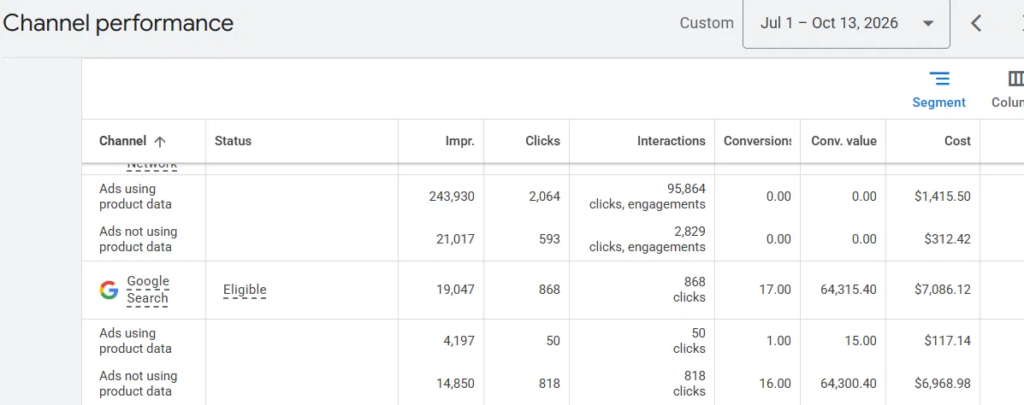
Figure 1: Performance Max channel performance for the campaign, July 1 to October 13, 2026.
| Row in the channel report | Impressions | Clicks | Conversions | Conversion value | Cost | Return (value divided by cost) |
|---|---|---|---|---|---|---|
| Google Search (total) | 19,047 | 868 | 17 | $64,315.40 | $7,086.12 | 9.1x |
| Search: ads not using product data | 14,850 | 818 | 16 | $64,300.40 | $6,968.98 | 9.2x |
| Search: ads using product data | 4,197 | 50 | 1 | $15.00 | $117.14 | 0.1x |
| Display Network: ads using product data | 243,930 | 2,064 | 0 | $0 | $1,415.50 | 0x |
| Display Network: ads not using product data | 21,017 | 593 | 0 | $0 | $312.42 | 0x |
Return is conversion value divided by cost, calculated by us from the report. The two Search sub-rows add up exactly to the Search total.
Four things stood out.
Search was where the money was. The Search row recorded 17 conversions worth $64,315.40 on $7,086.12 of spend, a return of about 9.1x.
Almost all of it came from ads that do not use product data. Those rows hold 16 of the 17 conversions, $64,300.40 of the $64,315.40 in value (99.98 percent), and 98.3 percent of the Search spend. As we read the report, these are ads built from headlines and descriptions rather than from the product feed. Each of those conversions was worth about $4,019 on average, at a cost of about $436 per conversion and $8.52 per click.
The product-data ads on Search did almost nothing. Fifty clicks, one conversion, and that conversion was worth $15 in a catalogue of products that sell in the thousands.
The display rows we can see produced no conversions. Roughly $1,728 and 2,657 clicks across the two Display Network rows, and zero conversions.
That did not match the story we had been told. The plan said Performance Max was the retargeting layer, and a retargeting-heavy campaign should show most of its action on display and video surfaces. This one was converting people who were searching.
Does that prove Search is the answer for big ticket products?
No, and we want to be straight about what the report can and cannot tell us. Four cautions came up before we trusted it.
Seventeen conversions is a small sample. When each sale is worth around $4,000, one or two orders can swing the return by several points. We treat 9x as a signal worth testing, not a result.
Some of those searches may be the brand name. If the Search conversions are mostly people typing the brand, Performance Max is harvesting demand that already existed. Nils Rooijmans, who writes a daily Google Ads newsletter, argued in a 2022 issue that brand traffic has “outrageously good conversion rates” that can flatter a campaign’s data. Performance Max now has search terms reporting, which Google added alongside the channel report, so you can read the actual queries instead of guessing.
The two conversion columns are not the same. Search Engine Journal pointed out that “Results” counts primary conversions grouped by goal, while “Conversions” includes secondary actions you track. If your account has secondary conversion actions, the numbers can differ depending on which you read.
Zero in a window is not the same as zero value. The display rows may have helped people along without getting credit. We cannot see assisted conversions in this table, and Google itself cautions against judging one channel’s return over a short window, because Performance Max optimises across all channels at once.
So here is what we can say: the plan we were given did not describe what the campaign was doing, and the evidence points toward query-driven Search as the part that converts for these products. That was enough for us to change the plan and run a test.
How do people actually buy expensive things?
People buying expensive things research for a long time and come back more than once, which is why query-level control matters. EMARKETER and impact.com found that after discovering a product, consumers usually research it at least three separate times before buying, that 22.8 percent research five or more times, and that consumers are more likely to spend over two weeks researching high-price, high-consideration items than cheaper ones.
Each of those research sessions is a chance for a search, and each search tells you what the person wants. A product name, a model, a comparison, a question about price or delivery. In our opinion, that is exactly where you want a campaign you control, because you can choose which of those searches you pay for and what the ad says back to them.
It also fits what practitioners say about Performance Max itself. Mike Ryan, Head of Ecommerce Insights at Smarter Ecommerce, put it plainly in a Performance Max Q&A:
“PMax is primarily a demand capture channel.”
Mike Ryan, Smarter Ecommerce
If Performance Max mostly captures demand that already exists, then for big ticket products it is capturing people who searched. Our channel report looks like that statement written in numbers. The question we wanted to answer was whether a dedicated Search campaign could capture that demand more deliberately.
How do Search, Shopping and Performance Max decide who serves?
Google’s help page on how Performance Max interacts with other campaigns sets the rules, and they matter for any structure that mixes these three.
- Search against Performance Max: a Search campaign with a keyword that exactly matches, or is spell-corrected to, a person’s query is preferred over Performance Max. If there is no exact match, the campaign with the higher Ad Rank serves.
- Standard Shopping against Performance Max: when both target the same product inventory, Google’s current page says the campaign with the highest Ad Rank serves. That is a change. Search Engine Journal reported in 2022 that Performance Max took precedence over Shopping campaigns for the same products. Mike Ryan describes the same shift, noting that ad rank became the deciding factor for hybrid setups in October 2024 and advising advertisers to pick one campaign type to put forward and give each meaningfully different targets and budgets.
In practice the overlap is bigger than the rules suggest. Frederick Vallaeys, co-founder and CEO of Optmyzr, published a study of 503 accounts covering February 2025. It found keyword overlap between Search and Performance Max in 91.45 percent of accounts and in 56.29 percent of 5,768 Search campaigns, including for exact match keywords. Most of the time the performance difference was small, but when it exceeded 10 percent on conversion rate, Search won 18.91 percent of the comparisons and Performance Max 6.17 percent. His summary is worth keeping:
“Search campaigns give you control. PMax gives you scale.”
Frederick Vallaeys, Optmyzr
The study also found a reason that matters to anyone adding a Search campaign: Performance Max picks up traffic when a Search campaign is ineligible to serve, for example because of a tight budget or narrow targeting. A Search campaign that is under-funded will not win the traffic you are hoping it will.
Why might Standard Shopping have produced so little?
We do not know yet, and we would rather say so than guess. There are several possible reasons, and each can be checked.
- It may be losing the auction. If Performance Max and Standard Shopping target the same products, the higher Ad Rank serves. Check the Standard Shopping campaign’s impression share lost to rank. A high number means it is losing auctions, not failing to convert.
- It may be a different slice of the catalogue. If Standard Shopping covers products Performance Max does not, that slice may simply be too small.
- It may not be getting clicks. Three months of very few clicks is a delivery problem. Three months of many clicks and no conversions is a different problem.
- The budget and bid strategy may be thinner than Performance Max’s. Next to a better-funded campaign, a lean Standard Shopping campaign quietly loses.
There is also something in Figure 1 that points the other way. The product-data ads inside Performance Max did almost nothing on Search either: 50 clicks, one $15 conversion. So the weak Standard Shopping result may not be only about structure. For this catalogue, ads driven by the product feed may not be what converts at these price points. We have not tested why. One idea is that a listing that shows a high price next to a photo asks the buyer to decide too quickly, where a text ad and a landing page can explain. That is a hypothesis, not a finding. If you want to keep Performance Max on product ads, see how to build and check a feed-only Performance Max campaign.
Can Performance Max actually do the retargeting job?
Partly, and the limit matters for how you read our test. You cannot tell Performance Max to retarget only people who visited your site. You can give it audience signals, such as your remarketing lists, and those guide the system without restricting it. Ginny Marvin, Google Ads’ product liaison, explained this in 2023, as reported by EMARKETER:
“Audience signals are not used as hard targeting constraints.”
Ginny Marvin, Google Ads
So when we say Performance Max “retargets”, we mean we point it at the right people and hope it leans that way.
There is a second lever. Google’s new customer acquisition goal works with Performance Max or Search campaigns, and lets you bid higher for new customers or bid for new customers exclusively. Google notes that even when you bid for new customers only, conversions from returning customers may still count toward your bidding goals. Mike Ryan has seen the same imperfection, and he also reports that Standard Shopping can show a lower share of returning customers than Performance Max, which he links to the dynamic remarketing inside Performance Max. He also points to Google’s own description of Performance Max as bottom-funnel rather than full-funnel. That fits our reading: it is built to close, not to open.
What are we changing, and how will we judge it?
We added a Search campaign for the best-selling products, to bring in new visitors with intent, and left Performance Max to do what it already does well. The division is simple: Search finds the person who is looking, and Performance Max brings back the person who visited and did not buy yet.
We are convinced enough to test it, and convinced is not proven. The first plan, Standard Shopping feeding Performance Max, was also a hypothesis, and we only learned it was shaky by looking at the data. We want to hold our own plan to the same standard, so we decided how to judge it before the results came in.
Account totals, not channel totals. This is the most important point. Because an exact match keyword takes priority over Performance Max, a new Search campaign can show good results simply by taking conversions that Performance Max’s own Search channel would have won anyway. In that case nothing new was created, and a number moved from one row of a report to another. So we look at total conversions and total return across the whole account against the period before.
New visitors. Is the account bringing in more first-time visitors, and does it show in Google’s new customer reporting? If the Search campaign adds no new people, it has failed at its first job.
Blended cost and return. Across all campaigns together. If this does not improve after the full window, we were wrong, or the change was too small to matter.
Performance Max’s share. Does its conversion share from Search fall as the new Search campaign takes over those queries, while it keeps converting returning visitors? That would match the story. If its Search share holds and total conversions do not rise, the plan did not do what we said.
Enough time. Big ticket purchases take time. Google’s “Days to conversion” report shows how long yours takes, and we judge over at least twice that gap, leaving out the most recent days because conversions are still arriving. Google’s Ginny Marvin advised in 2023 waiting about six weeks after assigning conversion values before changing a bidding strategy, so we avoid early verdicts. For more on volume, see how many conversions Smart Bidding needs.
A clean comparison where possible. A before-and-after comparison is weak evidence, because seasonality, promotions and stock all move results. A split test is better. We would rather have a smaller test we can trust than a big change we cannot interpret.
What would prove us wrong?
Several things, and we would like you to hold us to them.
- The Search conversions are mostly brand queries. Then the finding is about brand capture, not new demand.
- Seventeen conversions was luck. A small sample can mislead, and a 9x return may not hold.
- Adding Search just reshuffles credit. The new campaign looks successful and the account does not grow.
- Product-data ads convert better than we think over a longer window. Then Shopping deserves another look.
- This is one account. The products, price points and market are specific, and the pattern may not hold for yours.
- Google changes the rules. The Standard Shopping priority rule has changed once already, and anything we have linked may differ by the time you read this.
How should you run Google Ads for big ticket products?
If we were starting an account for big ticket products today, this is the order we would work in. It is our opinion, shaped by this experiment, and it will change if the test says so.
- Know your break-even before you start. Work out the return you need after margin with our break-even ROAS calculator and the ecommerce unit economics calculator. A 9x return means little until you know what break-even is.
- Protect your brand terms first. Run a brand campaign on exact match and use brand exclusions in Performance Max, so brand demand does not flatter the numbers.
- Build a Search campaign for the products that already sell. Use the terms buyers use, exact and phrase match first, and read the search terms report often. Our search term and negative keyword analyzer helps with that. Our Search Ads management work follows this approach.
- Give Performance Max a clear job and good data. That means enough conversions to learn from, clean audience signals, and segmentation that suits your catalogue, which we cover in Performance Max segmentation and our Performance Max management approach.
- Decide what Shopping is for. Our Google Shopping management experience says to choose a role for it rather than let it compete with Performance Max for the same products. Our campaign structure recommender can help you map this.
- Read the channel report before you believe a story about your account. Open it, check the format breakdown, and read the search terms.
- Judge at the account level, after the lag. See our wider view of Google Ads campaign types and how they fit together, and our own PMax vs Search benchmark, where we caught a reporting distortion in our own numbers.
Frequently asked questions
Is Search better than Performance Max for big ticket products?
In our experience so far, Search is the better first campaign, because you control which queries trigger the ads and what they say. In the Performance Max channel report we studied, almost all conversion value came from ads that did not use product data, on Search. This is one account and a small sample, so we treat it as a strong signal to test, not a rule.
Does Performance Max cannibalize Search campaigns?
Often it overlaps. Optmyzr’s study of 503 accounts found keyword overlap between the two in 91.45 percent of accounts. Google says an exact match keyword is preferred over Performance Max, but a Search campaign that is ineligible, for example because of budget, can lose traffic to it. Check both campaigns’ search terms.
Can Performance Max retarget only past visitors?
No. Audience signals guide Performance Max but do not restrict it, as Google’s Ginny Marvin has said. You can bid higher for new customers or only for new customers with Google’s new customer acquisition goal, but returning customers can still count.
Why did our Standard Shopping campaign get so few conversions?
Several reasons are possible: it may lose auctions to Performance Max when both target the same products, it may cover a small slice of the catalogue, or it may be under-funded. Check its impression share lost to rank, its clicks, and its budget before concluding the channel does not work.
How long should you wait to judge a big ticket campaign?
At least twice your conversion lag, excluding the most recent days. Check the “Days to conversion” report. People researching expensive products often take weeks, so an early verdict is usually a wrong one.
About The Author